















Game Description
EVIL NEIGHBOR 2
1. Game Overview
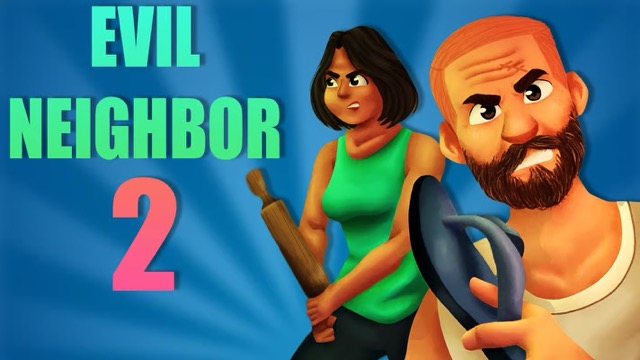
Evil Neighbor 2 is a first-person horror escape game that raises the stakes of its predecessor in every dimension. The house is bigger, the puzzles are more complex, and the threat has doubled — your neighbor and his wife are both on the lookout, making every move across this expanded environment a calculated risk. You are trapped, the clock is ticking, and your only way out is to outthink two people who know this house far better than you do.
The game's first-person perspective is central to its tension. There are no third-person safety margins, no bird's-eye map to reference — just your own eyes, a house full of locked doors and hidden items, and two enemies whose patrol routes you'll need to learn through careful observation and hard experience. The claustrophobic intimacy of seeing through your character's eyes makes every creaking floorboard and distant footstep feel personal.
What distinguishes Evil Neighbor 2 from straightforward hide-and-seek horror games is the layer of puzzle-solving woven into the escape. Getting out isn't just about avoiding your neighbors — it requires actively engaging with the house's environment, finding hidden items, solving challenges that gate the doors between you and freedom, and doing all of this under constant time pressure. For players who want their horror served with a generous helping of mental challenge, Evil Neighbor 2 delivers a complete and deeply replayable experience.
Key Details:
| Detail | Info |
|---|---|
| Genre | First-Person Horror Escape / Puzzle |
| Difficulty Level | Medium to Hard |
| Average Play Time | 25–50 minutes |
| Best For | Horror puzzle fans who enjoy first-person stealth escape gameplay with multiple threats and time pressure |
2. How to Play
Getting Started:
- The game begins inside the neighbor's house — take stock of your immediate surroundings before moving.
- Explore rooms carefully to locate hidden items needed to unlock doors and solve puzzles.
- Monitor sound cues to track the neighbor and his wife's positions before committing to movement.
- Use found items to solve puzzles, unlock doors, and open new areas of the house.
- Reach the exit before the time limit expires without being caught by either pursuer.
Basic Controls:
- Move: W / A / S / D
- Look Around / Interact: Mouse
- Pick Up / Use Items: E
- Run: Shift (use sparingly — creates noise)
- Crouch: Ctrl (reduces noise and visibility — your primary stealth tool)
- Jump: Space
Objective: Escape the neighbor's house before time runs out. Find hidden items, solve the puzzles that lock the house's doors, and avoid detection by both the neighbor and his wife throughout your escape.
3. Game Features & Highlights
✓ Expanded house environment — a larger map than the original with more rooms, more items, and more complex puzzle chains to navigate ✓ Dual-pursuer threat system — the neighbor and his wife patrol independently, requiring you to track two separate threats simultaneously ✓ Time-limited escape — a countdown clock adds urgency to every puzzle and exploration decision, preventing overly cautious play ✓ Full first-person perspective — maximum immersion with no external view, making spatial awareness a core skill rather than a given ✓ Rich interaction system — a complete movement toolkit including running, crouching, and jumping gives you genuine options for navigating and hiding
4. Tips & Strategies
Beginner Tips:
- Crouch as your default movement mode when exploring — the noise reduction is significant and neither pursuer will hear you approaching from adjacent rooms if you're consistently crouched.
- Map the house mentally as you explore each new room — knowing which rooms connect to which is essential for planning fast hiding routes when either pursuer changes direction toward you.
- Prioritize finding items over solving puzzles on your first pass through each area — knowing what you have before deciding how to use it prevents backtracking across dangerous ground.
Advanced Strategies:
- Learn both pursuers' patrol routes across multiple runs — the neighbor and his wife cover different areas of the house, and understanding where each one goes creates predictable safe windows for movement and searching.
- Use the Shift sprint only when you're certain neither pursuer is within audio range — the noise generated by running travels significantly farther than crouched movement and can alert both pursuers simultaneously.
- Time-critical players should identify the fastest puzzle completion sequence rather than solving challenges in the order they're encountered — some early-game puzzles unlock shortcuts that dramatically reduce the total distance traveled.
What to Watch Out For:
- Two-front threats: The neighbor and his wife can inadvertently create pincer situations where one is ahead of you and one is behind. Always confirm the position of both before moving through a connecting corridor or doorway.
- Time mismanagement: The puzzle-solving focus can make it easy to forget the clock. Set a mental checkpoint — if you haven't made significant escape progress by the midpoint of the time limit, prioritize the critical path over thorough exploration.
5. Game Elements Explained
The Dual-Pursuer System: The addition of the neighbor's wife as a second active pursuer is the defining mechanical upgrade of Evil Neighbor 2 over its predecessor. In the original game, tracking one pursuer's position and planning movement around a single patrol was the core stealth challenge. In Evil Neighbor 2, you must monitor two independent patrol routes simultaneously — the neighbor and his wife cover different areas and move on different schedules, creating situations where avoiding one may move you toward the other. The key skill is learning to hold both positions in your mental model at all times, using audio cues from each pursuer to triangulate the safest movement windows. Players who treat the dual-pursuer system as two separate problems to manage in sequence will struggle; those who develop simultaneous awareness of both threats will find the house significantly more navigable.
The Puzzle and Item Chain: Escaping the neighbor's house requires solving a connected sequence of puzzles gated by items scattered throughout the environment. Items are not randomly distributed — their locations are consistent between runs, which means knowledge compounds across multiple playthroughs. Each item connects to a specific puzzle or door, and understanding those connections transforms the escape from a process of trial-and-error into an efficient sequence of targeted collection and application. The expanded house in Evil Neighbor 2 means this chain is longer and more branching than in the original — some items unlock areas that contain other items needed for later puzzles, creating a dependency structure that rewards players who explore methodically rather than rushing toward the exit.
The Time Pressure System: The time limit in Evil Neighbor 2 is not just a difficulty modifier — it is a fundamental design element that shapes how you must approach every decision in the game. Without it, the optimal strategy would be extreme caution: hide indefinitely, move only when both pursuers are far away, and take as long as needed between each puzzle step. The time limit eliminates this option entirely, forcing you to accept calculated risks and maintain forward momentum even when the situation isn't perfectly safe. This creates a genuine tension between the stealth instinct (wait until it's safe) and the time pressure reality (you cannot always wait). Managing that tension — deciding when a risk is acceptable and when it isn't — is the central skill of Evil Neighbor 2's gameplay.
6. Frequently Asked Questions
Q: How do I track where both pursuers are at the same time? A: Rely primarily on audio — both the neighbor and his wife produce distinct footstep and movement sounds that carry through walls. Train yourself to listen for both simultaneously rather than focusing on one at a time. Brief, deliberate pauses before entering new areas let you assess both audio streams and update your mental map of their positions before committing to movement.
Q: What should I do if one of the pursuers spots me? A: Sprint immediately toward the nearest room with a hiding option — inside a closet, under furniture, or behind a large object — and crouch. Stay completely still until both audio signatures indicate the pursuers have returned to their patrol routines. Do not exit hiding until you've confirmed both pursuers have moved away, not just the one who spotted you.
Q: Is Evil Neighbor 2 compatible with mobile browsers? A: The WASD movement, mouse-look, and multi-key control scheme are designed for desktop keyboard-and-mouse play. Mobile browser access is possible but the full control set — particularly the distinction between run, crouch, and jump — is significantly less comfortable on touchscreen. Desktop is the recommended platform.
Q: Can I save my progress mid-game? A: Evil Neighbor 2 does not feature mid-session manual saves. The time-limited structure is designed for single-session completion. Progress is maintained within your current browser session; closing the browser will reset the run.
Q: How does Evil Neighbor 2 differ from the original Evil Neighbor? A: Evil Neighbor 2 expands the original in three key ways: a larger house with more rooms and a longer puzzle chain, the addition of the neighbor's wife as a second independent pursuer, and a more complex item-interaction system with additional puzzle types. Players who completed the original will find the sequel meaningfully more challenging rather than simply more of the same.
7. Related Games You Might Enjoy
If you like Evil Neighbor 2, you might also enjoy:
- Evil Neighbor 3 - Another neighbor-horror escape game built around stealth, exploration, and tension.
- The House Of Evil Granny - A related horror game with similar survival pressure and unsettling atmosphere.
- Granny Returns 3D : Evil Destiny - A related horror game with similar survival pressure and unsettling atmosphere.
Comments (0)
Add a Comment