






Game Description
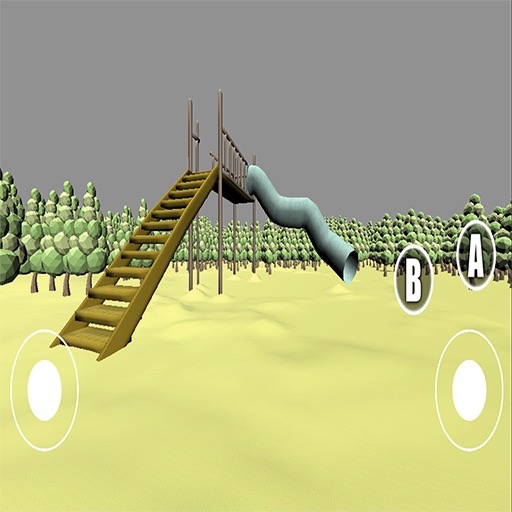
SLIDE IN THE WOODS
1. Game Overview
Slide In The Woods is a minimalist first-person horror game built around one of the most deceptively simple premises in the genre: you are alone in a dark forest, there is a slide, and you must never stop using it. What sounds like an absurd setup becomes genuinely unnerving almost immediately — because the moment you stop sliding, something in the darkness takes notice.
The game is a masterclass in using a single rule to generate sustained tension. There are no weapons, no inventory, no complex mechanics to learn. There is only the forest, the slide, the night, and the absolute necessity of keeping the motion going. During the day you can see the threats clearly enough to orient yourself. As night falls, visibility collapses and finding the slide in the dark becomes its own terrifying challenge — your flashlight cutting only a narrow cone through the trees while something watches from beyond its reach.
What Slide In The Woods does exceptionally well is transform a mundane, even joyful activity — playing on a playground slide — into a source of genuine dread. The juxtaposition of the ordinary (a slide, a clearing, daylight) against the threatening (total darkness, unseen enemies, forced motion) is where the game's horror lives. It doesn't rely on gore, jump scares, or elaborate monster designs — just a rule, a forest, and the very human fear of what happens when you stop.
Key Details:
| Detail | Info |
|---|---|
| Genre | First-Person Atmospheric Horror |
| Difficulty Level | Medium |
| Average Play Time | 15–30 minutes |
| Best For | Horror fans who appreciate slow-burn atmospheric tension and minimalist design over action-based scares |
2. How to Play
Getting Started:
- The game opens in first-person in a forest environment — locate the slide near your starting position.
- Begin using the slide and establish a continuous motion rhythm as quickly as possible.
- Use your flashlight to navigate the environment once visibility drops at night.
- Never stop your motion on the slide — pausing invites an attack from the unseen threat.
- Survive through the full night cycle until the threat recedes.
Basic Controls:
- Move: WASD or arrow keys
- Look Around: Mouse
- Use Flashlight: F key or designated button
- Adjust Sensitivity: In-game settings menu (recommended to configure before starting)
- Interact with Slide: Approach and use the designated interaction key
Objective: Stay in continuous motion on the slide and survive the night without stopping. Use your flashlight to locate the slide in the dark and maintain your rhythm. Stopping — even briefly — puts you at immediate risk of attack.
3. Game Features & Highlights
✓ Singular core mechanic — the "never stop sliding" rule creates a uniquely simple but deeply effective and sustained tension system ✓ Dynamic day-night cycle — the transition from visible daylight to near-total darkness fundamentally changes the challenge and atmosphere mid-session ✓ First-person perspective — maximum immersion places you directly in the character's position with no buffer between you and the threat ✓ Adjustable sensitivity — customizable mouse sensitivity ensures smooth, comfortable movement for players of all preferences ✓ Minimalist horror design — builds sustained dread through atmosphere, sound, and a single rule rather than monster reveals or jump scares
4. Tips & Strategies
Beginner Tips:
- Before night falls, memorize the path from the slide's base back to its top — you'll need to navigate it in near-total darkness and muscle memory is more reliable than vision.
- Adjust your mouse sensitivity in settings before starting; the default may be too fast or slow for comfortable first-person navigation in low-visibility conditions.
- Keep your flashlight pointed slightly ahead and downward rather than straight forward — it illuminates the ground path to the slide more reliably than sweeping it at eye level.
Advanced Strategies:
- The slide's position is fixed — once you've identified its location relative to specific trees or landmarks, use those landmarks as navigation anchors in the dark rather than relying on your flashlight sweep alone.
- The threat responds to stillness, not to walking between slide runs — moving between the base and top of the slide counts as motion. Only standing completely still triggers the danger.
- Resist the instinct to scan for the threat when you feel unsafe. It costs you orientation time and the threat is not visible anyway. Trust your motion and your landmarks.
What to Watch Out For:
- Losing the slide in the dark: The transition from day to night is the most dangerous moment in the game. If you haven't memorized the slide's position before visibility drops, relocating it with just a flashlight is genuinely difficult and stress-inducing.
- Freezing when threatened: When something feels wrong, the instinct is to stop and assess. This is exactly backwards in Slide In The Woods. If you feel threatened, maintain or increase your motion — stopping is the only thing guaranteed to make the situation worse.
5. Game Elements Explained
The Core Motion Rule: The foundational mechanic of Slide In The Woods — never stop moving on the slide — is what separates this game from standard walking simulators or exploration horror. The rule creates a constant low-level anxiety that colors every other action: navigating to the slide from its base, adjusting position, checking landmarks. Everything is filtered through the question of whether you've been stationary for too long. The threat that enforces the rule is never explicitly shown or explained — a deliberate design choice. An unseen threat with clear rules is more psychologically effective than a visible monster whose behavior can be learned and predicted. The rule itself is simple; staying calm enough to follow it under mounting pressure is not.
The Day-Night Visibility System: The game's difficulty is directly tied to its day-night transition. In daylight, the forest is navigable and the slide is clearly visible — the threat exists but the environment is manageable. As night falls, visibility collapses dramatically. Your flashlight becomes your only navigational tool, casting a limited cone of light through an otherwise completely dark forest. Finding the slide, maintaining your position relative to it, and staying in continuous motion all become substantially harder in the dark. The night phase is where tension peaks — and where your preparation during daylight directly pays off. Players who used the day phase to memorize the slide's position relative to landmarks navigate the night significantly more effectively than those who didn't think ahead.
The Atmospheric Sound Design: Sound does the heavy lifting in Slide In The Woods that most horror games assign to visual threats. The forest ambient audio shifts as night approaches — familiar outdoor sounds are gradually replaced by sounds with no clear natural source. The slide itself produces audio as you use it, which paradoxically functions as a safety signal — the familiar creak and motion of the slide means you're still moving. Silence is the danger signal here. If the ambient audio shifts into something that feels wrong, the correct response is to move faster, not to stop and listen more carefully. Learning to interpret the soundscape as information rather than react to it emotionally is the key to sustained survival across the full night cycle.
6. Frequently Asked Questions
Q: How do I find the slide when it gets dark? A: Use your flashlight and move based on your daytime memory of the slide's position. Fixed landmarks — distinctive trees, the shape of the clearing — are more reliable guides than visual scanning. If completely disoriented, move slowly in one direction until a familiar landmark appears, then reorient from there before continuing.
Q: What exactly happens if I stop moving? A: The unseen threat attacks when you remain stationary. The attack arrives without a visible monster reveal — the game communicates it through audio and an abrupt sequence. The specific nature of the threat is intentionally left ambiguous, which is part of what makes stopping feel genuinely dangerous rather than just mechanically penalized.
Q: Is Slide In The Woods compatible with mobile browsers? A: The game is playable on mobile but the first-person mouse-look controls are significantly less comfortable on touchscreens than on desktop with a mouse. The sensitivity adjustment in settings helps, but desktop is the recommended platform for the intended experience.
Q: Can I adjust the flashlight brightness or range? A: The flashlight's characteristics are fixed by the game. What you can adjust is the sensitivity of your mouse and look controls, which affects how efficiently you can sweep the light across the environment while navigating in the dark.
Q: Does the game have an ending, or is it purely survival-based? A: Slide In The Woods has a defined conclusion tied to surviving the full night cycle. Maintaining motion until the threat's active period ends completes the game. The ending is deliberately understated — consistent with the game's minimalist design philosophy throughout.
7. Related Games You Might Enjoy
If you like Slide in the Woods, you might also enjoy:
- Hungry Lamu - A related horror game with similar survival pressure and unsettling atmosphere.
- Five Nights at Freddys 10 - A related horror game with similar survival pressure and unsettling atmosphere.
- Freddys Runner - A related horror game with similar survival pressure and unsettling atmosphere.
Comments (0)
Add a Comment