












Game Description
Granny House
1. Game Overview
Granny House strips the survival horror escape formula down to its most essential and merciless form: an abandoned mental asylum, you, and Granny. No combat options, no distraction items, no puzzle systems to fall back on between encounters. Just stealth, observation, and the precise identification of the moment when it's safe to move. If Granny catches you, the game ends immediately — not a setback, not a health depletion, a full stop. This consequence structure makes every step through the asylum a genuine commitment rather than a recoverable risk.
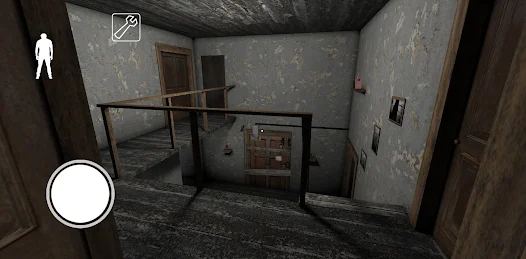
The asylum setting is more than an atmospheric choice. Mental institutions carry a specific cultural weight in horror — spaces defined by confinement, where the architecture itself communicates the impossibility of easy exit. Granny has claimed this particular building as her territory, and she monitors it with the focused attention of someone who knows every corner and expects intrusions. The darkness that fills the facility is functional as well as atmospheric: vision is limited, spatial awareness requires genuine attention to the sounds and light conditions around you, and the hiding spots that keep you alive require knowing the space well enough to reach them without making noise in the process.
The game's emphasis on stealth, observation, and timing distinguishes it from Granny entries that offer players more active options. There are no weapons to pick up, no thrown objects to create diversions, no difficulty settings to ease the pressure. What there is, is the methodical, patient experience of learning a space through repeated careful movement — building a mental map of Granny's patrol habits, identifying the safe windows when movement is possible, and executing the escape route with the precision the asylum demands. For players who want their horror delivered through sustained, unrelenting tension rather than varied mechanics, Granny House is one of the purest expressions of the genre.
Key Details:
| Field | Info |
|---|---|
| Genre | Stealth Survival Horror / Pure Escape |
| Difficulty Level | Hard |
| Average Play Time | 10–25 minutes per attempt |
| Best For | Hardcore stealth horror fans, players who enjoy learning through repeated attempts, pure tension horror enthusiasts |
2. How to Play
Getting Started:
- Enter the asylum and immediately pause to listen — Granny's position is audible before it's visible, and knowing her starting location informs your first movements.
- Move with WASD or arrow keys and default to slow, deliberate movement throughout — noise is your greatest enemy and fast movement is noise.
- Use Left Shift to increase speed only when it's immediately necessary — Granny will hear you if you run.
- Use Space to jump obstacles when the path requires it, but jump sparingly — landing generates noise.
- Exploit darkness and hiding nooks to evade Granny's detection — the asylum's layout is designed with concealment opportunities that reward players who know where they are.
Basic Controls:
- WASD or Arrow Keys — Move through the asylum
- Space — Jump
- Left Shift — Speed up (use sparingly)
Objective: Escape the abandoned mental asylum without being detected by Granny. Navigate using stealth and spatial awareness, exploit the darkness and hiding spaces the facility provides, and find the correct moment to move through each area. Being caught ends the game immediately — there are no second chances within a run.
3. Game Features & Highlights
✓ Immediate-end detection — Being caught ends the game instantly, removing the safety net that makes cautious play merely habitual rather than genuinely necessary
✓ Pure stealth design — No combat, no distractions, no difficulty adjustments — survival is achieved entirely through movement discipline and spatial awareness
✓ Abandoned asylum setting — An architecture of confinement that amplifies the claustrophobia of the escape scenario
✓ Dark environment with hiding nooks — The facility's darkness is both atmospheric and mechanical, rewarding players who navigate by it rather than against it
✓ Anticipation-driven tension — The constant need to identify the right moment before moving creates sustained psychological pressure that other horror games achieve only in peak moments
4. Tips & Strategies
Beginner Tips:
- Your first several attempts should prioritize mapping the asylum over escaping it — learning which rooms connect to which, where Granny tends to patrol, and where the hiding nooks are located is the foundational knowledge everything else requires
- Default to walking speed at all times and use Left Shift exclusively for emergency repositioning — the noise difference between walking and running is significant enough that treating running as a last resort rather than a time-saver prevents the majority of detections
- Listen continuously — Granny's footsteps and ambient presence sounds are your most reliable information source about her current position and direction of travel
Advanced Strategies:
- Learn Granny's patrol pattern in each area of the asylum — her movement isn't random, and the windows when she's facing away from or moving away from your intended path are the correct moments to advance
- Use the asylum's darkness proactively: move through the darkest available route between any two points rather than the most direct one — reduced visibility for you means reduced visibility for Granny
- Develop a mental countdown for how long you can safely remain in any given position before Granny's patrol brings her back — time your movements relative to this cycle rather than reacting to her appearance after the fact
What to Watch Out For:
- The impulse to move when scared — Panic-movement is the most reliable cause of detection in Granny House; when Granny is close and getting closer, staying completely still in the nearest dark area is almost always safer than attempting to move away from her
- Jump sounds in quiet areas — The Space key generates landing noise that can attract Granny's attention if she's nearby; avoid jumping near her patrol path unless an obstacle makes it strictly necessary
5. Game Elements Explained
Immediate Consequence Structure: The design choice to end the game immediately upon detection rather than imposing a health depletion or partial failure is the most defining mechanical decision in Granny House. This single design element transforms the stealth requirement from a preferred approach into an absolute necessity — there is no cushion, no retry window within a run, no ability to absorb a single mistake and continue. Every movement through the asylum is therefore a genuine commitment with immediate terminal consequences if misjudged. This structure produces the game's specific psychological atmosphere: not the tension of managing a depleting resource or the frustration of repeatable near-misses, but the focused, almost meditative attention that comes from knowing that a single poorly chosen step ends everything. Players who find this consequence structure rewarding rather than punishing are the game's target audience, and for them it creates some of horror gaming's most memorable tension.
Stealth as the Sole Survival Mechanism: Granny House offers no combat options, no distraction items, no environmental tools that add mechanical variety to the core stealth requirement. This is a deliberate design choice: by removing every alternative to stealth, the game forces players to become genuinely skilled at stealth rather than competent enough to escape a difficult moment with a timely distraction. The skills required are specific — movement speed discipline, continuous audio monitoring, pattern recognition of Granny's patrol behavior, spatial memory of the hiding nooks' locations, and the timing judgment to move through exposed areas during the exact windows when Granny's position makes detection least likely. Each of these skills develops across attempts in a way that makes the game's difficulty curve feel earned rather than arbitrary: you get better at Granny House by playing it, and the improvement is tangible.
The Asylum's Spatial Design: The abandoned mental asylum is designed as a horror environment in both aesthetic and mechanical terms. Its room-corridor architecture creates natural chokepoints that Granny monitors and that must be timed carefully to pass through safely. The overall layout is complex enough to require genuine spatial learning — which corridors connect to which rooms, where the dead ends are, which routes offer dark cover and which expose you in lit areas. The darkness that fills most of the facility is not uniform: some areas have more environmental lighting than others, and the hiding nooks are distributed in positions that require knowing the space to find quickly. The asylum rewards players who have mentally mapped it across multiple attempts and can navigate it efficiently — not despite the darkness but because they know the layout well enough that darkness doesn't slow them down.
6. Frequently Asked Questions
Q: What should I do when Granny is approaching my position and I can't find a hiding spot? A: Stop moving completely and press yourself against the nearest wall or into the darkest available area. Granny's detection in Granny House responds to movement and noise — complete stillness in a dark area is your best remaining option when a designated hiding nook is not accessible. Do not attempt to run; the noise generated will make detection certain rather than probable.
Q: How do I learn the asylum layout without dying repeatedly? A: Repeated attempts are the intended learning mechanism. Treat each run as an information-gathering exercise: learn one new room's layout, one new patrol section of Granny's route, or one new hiding nook per attempt. The knowledge accumulates across runs, and after five to ten attempts the layout will feel significantly more navigable than it did at the start.
Q: Is Granny House compatible with mobile or touchscreen devices? A: Granny House uses WASD/arrow key movement and Left Shift for speed modulation. The precision stealth requirements — including the immediate consequence structure for detection — benefit from keyboard control. Touchscreen compatibility varies by device and browser. Desktop or laptop play is recommended.
Q: Can I save progress during a run? A: Granny House is designed as a single continuous escape attempt — being caught ends the run and progress within that attempt is not saved. Knowledge gained about the asylum's layout and Granny's patrol patterns is the persistent resource that carries across runs rather than in-game progress.
Q: Is there any way to fight back or distract Granny? A: No — Granny House offers no combat or distraction mechanics. The game's design is deliberately limited to stealth as the sole survival approach. If this feels restrictive, it is intentional: the limitation is what creates the game's specific and sustained tension. There are no mechanical shortcuts between you and the exit — only the quality of your stealth.
7. Related Games You Might Enjoy
If you like Granny House, you might also enjoy:
- The House Of Evil Granny - A stealthy house-horror game where careful movement and escape planning matter.
- Granny Returns 3D : Evil Destiny - A stealthy house-horror game where careful movement and escape planning matter.
- Granny Horror 2 - A stealthy house-horror game where careful movement and escape planning matter.
Comments (0)
Add a Comment